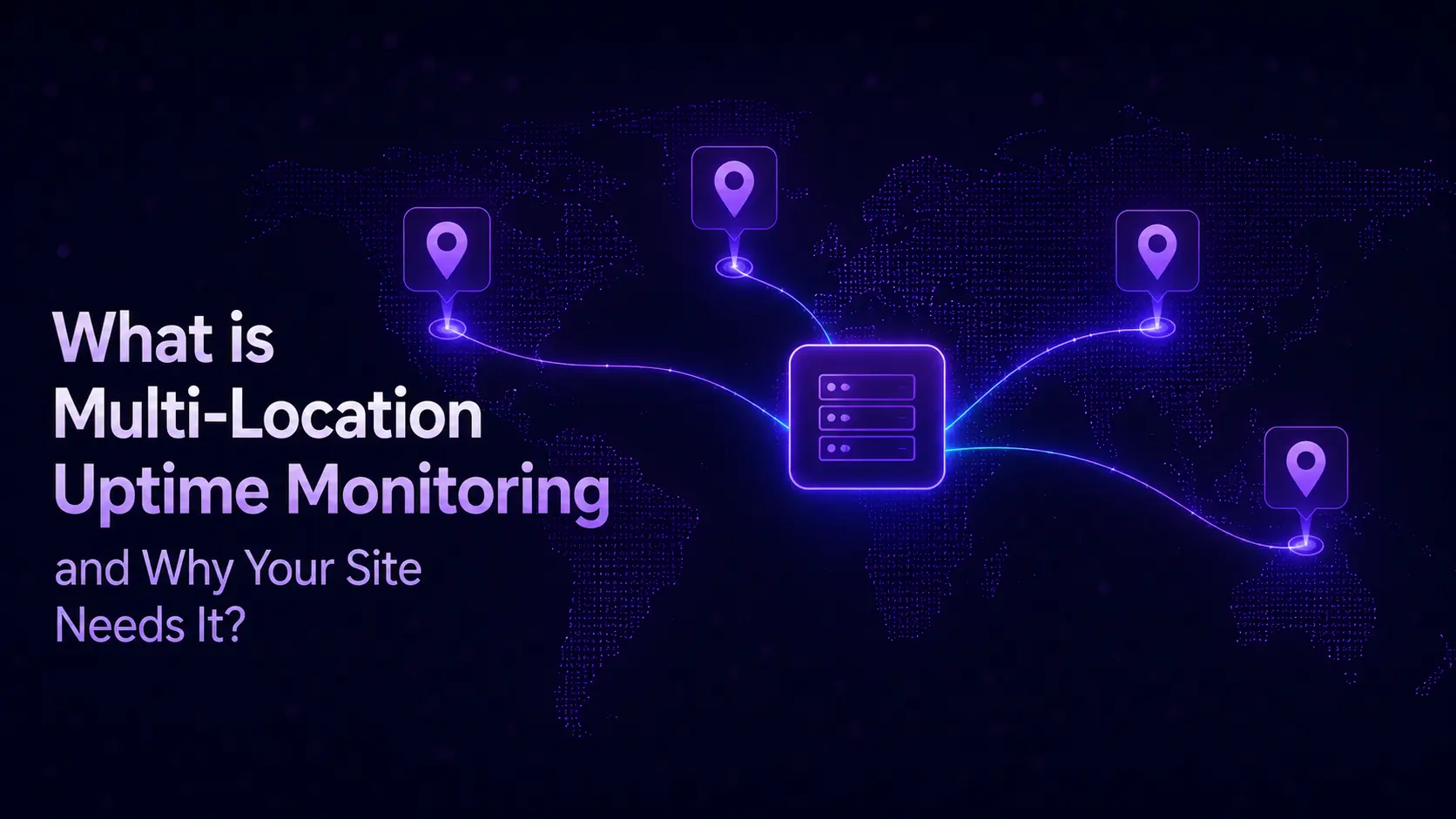
One of the most common reasons website owners stop trusting their monitoring tool is this: an alert says "site is down," you rush to check, and the site is perfectly fine. This is called a false positive, and the root cause is almost always the same — your monitoring tool checks your site from only one geographic location. In this article we explain what multi-location monitoring is, why it matters, and how it makes your alerts actually trustworthy.
This matters even more for sites and businesses with an Iranian audience, since network routes between Iran and servers abroad sometimes have their own fluctuations that single-location monitoring simply can't see correctly.
What Exactly Is Wrong With Single-Location Monitoring?
When a monitoring tool checks your site from only one server in one country, it's measuring your site's status from a single point of view. The problem: an outage report doesn't always mean your site is actually broken. Common scenarios that trigger false alerts:
- A temporary outage at the monitoring server or its data center itself
- A routing issue between that specific server and your site
- Temporary network filtering or restrictions in one region
- A short-lived DNS fluctuation visible only from one region
In every one of these cases, your site is completely healthy for most real users — but because only one node was checking, a false alert went out. The practical cost: unnecessary stress, wasted time investigating a problem that doesn't exist, and worst of all — you eventually start ignoring real alerts too, because you no longer trust the system.
How Does Multi-Location Monitoring Actually Work?
With multi-location monitoring, your site or API is checked simultaneously from several monitoring nodes in different geographic regions (e.g., Iran, Europe, Asia, the US). The alerting logic changes too: instead of "one node said it's down, so it's down," the system waits for agreement across multiple nodes.
- Multi-node consensus: an alert only fires when most or all nodes fail to reach your site at the same time.
- Isolating where the problem is: if only one node reports an outage, the issue is likely that region's route, not your server.
- Real TTFB visibility: Time to First Byte is measured from multiple regions' perspective, not just one.
- Drastically fewer false positives: a single local hiccup is no longer enough to trigger an alert on its own.
Why This Matters Even More for Iranian Websites
Iran's internet infrastructure, for various structural and policy reasons, occasionally experiences fluctuations on specific international routes. This means:
- If your monitoring runs only from outside Iran, a temporary route fluctuation could trigger a false down alert while Iranian visitors see your site loading just fine.
- Conversely, if you monitor only from inside Iran, a real outage affecting only international visitors might go completely unnoticed.
The fix is having both a node inside Iran and international nodes at the same time. This combination gives you the closest possible picture to the real experience of all your users — not just a subset of them.
Comparison Table: Single-Location vs. Multi-Location Monitoring
| Criteria | Single-Location | Multi-Location |
|---|---|---|
| False positive rate | High | Low |
| Pinpointing the problem (server vs. network route) | Impossible or guesswork | Accurate |
| Visibility into Iranian + international users | Only one region | All regions |
| Trust in the alerts you receive | Erodes over time | High and stable |
Checklist for Choosing a Multi-Location Monitoring Tool
Before choosing or switching monitoring tools, ask yourself:
- How many active nodes does it have, and in which countries/cities?
- Does it have a node close to your main audience (e.g., Iran)?
- What's the alerting rule? Is one node enough, or does it require multi-node agreement?
- Does it report per-node? Can you see TTFB for each region separately?
- Do alerts reach you fast via Telegram/email/Webhook?
Recommended Solution: Multi-Location Monitoring With Uptime Plus
Uptime Plus is built exactly to solve this problem: simultaneous monitoring from multiple nodes inside Iran and internationally, instant Telegram alerts, and accurate per-region TTFB reporting. That means you'll know exactly whether the problem is your server or a specific network route — and false positives stop being something you have to worry about.
Conclusion
Monitoring from a single point is no longer enough, especially when your audience is spread across multiple countries — or even just across Iran. Multi-location monitoring isn't just an extra feature; it's the difference between alerts you can actually trust and alerts that just add stress.



Comments 0
Login to comment
To add a comment, please login first.
No comments yet.